Affiliate & bonus offers
Build Your Own Brand: 7 Steps for the Self-Employed
How to build your brand from the inside out, so that it doesn't just look good but reaches customers
AdvertisementBlueprint360 · Quality 100 % · 🎁 Exclusive bonus worth €131See the bonus ↓
Note: This article contains promotion of our own product, the Marken-Blueprint 360° from Architekt des Erfolgs.
When people go self-employed, they often start with what is visible: logo, colours, website, Instagram profile. It feels productive. After a few weeks you have a lovely design, but the enquiries fail to appear. The reason is almost always the same: the brand was built from the outside in, instead of from the inside out.
In this article you will learn how to build your own brand step by step, so that it doesn't just look good but reaches people who want to buy from you. The seven steps work for coaches, consultants, service providers and anyone who sells their knowledge.
What a brand really is
A brand is not your logo. A brand is the picture that forms in other people's minds when they think of you. The logo, the colours and the website are just tools to support that picture.
For the self-employed, that means your brand is made up of three things. First, who you are and what you stand for. Second, who you work for and which problem you solve. Third, how you talk about it. If these three points are clear, the design is almost a formality. If they are unclear, even the most beautiful design won't help.
Step 1: Write down your story
People buy from people. Especially when you sell knowledge or services, potential customers want to know who is behind the offer. Your story is not a CV, but an answer to the question: why do you do what you do?
Answer these questions in writing for yourself:
- Which experiences brought you to your topic?
- Which mistake did you make yourself that your customers make today?
- What changed for you when you found the solution?
- Why does this topic matter to you today?
From the answers, a short biography of three to five paragraphs emerges. You will use this biography later on your website, in your LinkedIn profile, in introduction rounds and in the first email to new contacts.
Step 2: Narrow down your target group
The most common mistake in building a brand is trying to speak to everyone. If you are there for everyone, you are special to no one. A narrow target group feels risky at first, but it makes everything easier: copy, offers, prices and client acquisition.
A good target group description includes:
- a clear life or work situation, for example nurses working shifts or trade businesses with up to ten employees
- a concrete problem these people have today
- a goal they want to reach
- reasons why they haven't managed it on their own so far
You can always broaden later. The other way round is much harder.
Step 3: Your positioning in one sentence
When someone asks what you do, you need a sentence that people can pass on. A simple formula for this is:
I help [whom] to achieve [what result] without [what annoys them today].
An example: ‘I help self-employed people get their bookkeeping done in one hour a week, without the annual shock at the tax adviser's.’ The sentence names a target group, a result and a pain point. It is concrete enough that people know straight away whether it is about them or whether they know someone it could be about.
Test your sentence on three people. If they ask how you do that, you are on the right track. If they nod politely, the sentence is still too general.
Step 4: Your values and your tone of voice
Two self-employed people with the same offer can come across in completely different ways. One is matter-of-fact and analytical, the other warm and encouraging. Both can work, as long as it suits you and stays consistent throughout.
Decide for yourself:
- three values you stand for, for example honesty, clarity and down-to-earth manner
- how you address your customers, with the informal Du or the formal Sie
- which words you like to use and which you never use
- how long your sentences typically are
Write this on a single sheet. This sheet is your brand factsheet. It makes sure your website, your posts and your emails sound as if they come from the same person.
Step 5: The visible appearance
Only now, once story, target group, positioning and tone of voice are clear, does the design come in. The questions are then much easier to answer: which colours suit your values? Which typeface suits your tone of voice? Which images suit your target group?
To get started, you need:
- two to three colours
- one typeface for headings and one for body text
- a simple logo or a wordmark
- a good portrait photo
- a visual style that repeats
You don't need more at the start. A consistent, calm appearance looks more professional than an elaborate one that keeps changing.
Step 6: An offer that people understand
A brand without an offer is a hobby. Word your first offer so that a stranger understands within a minute what they get, who it is for and what it costs.
Describe results rather than services. ‘Six coaching sessions’ says little. ‘After six weeks you have an offer you can sell’ says a lot. Customers don't buy your time, but what changes for them.
A word on price: don't set it by gut feeling. Work out what you need at a minimum, and then ask yourself what the result is worth to your customer. A clear positioning generally allows you higher prices, because you are compared with others less.
Step 7: Test your brand in conversation
The best test for your brand is real conversations. Talk to people from your target group before you put a lot of money into advertising or an elaborate website. Pay attention to the words they use to describe their problem. Those words belong in your copy.
A simple start: write to ten people in your circle, tell them in one sentence what you do now, and ask whether they can think of anyone who might find that interesting. A recommendation from an acquaintance often opens more doors than any advert.
Typical mistakes when building a brand
Many founders stumble over the same hurdles. If you know them, you save yourself months.
- Starting with the design: Logo and colours before the positioning almost always lead to a second, expensive round.
- Something new every month: If you keep changing colours, slogan or target group, you stick in nobody's mind. A brand needs repetition.
- Copying instead of developing: Rebuilding the brand of a successful competitor quickly looks fake. Nobody can copy your story.
- Staying behind closed doors too long: A brand that never meets real people remains a guess. The earlier you test it in conversation, the better it becomes.
- Buying yet another course: Anyone who already knows a lot and still isn't making progress usually doesn't need another course, but a clear sequence and the courage to begin.
Checklist: building your own brand
- Story: biography of three to five paragraphs
- Target group: clear description with situation, problem and goal
- Positioning: one sentence that people can pass on
- Values and tone of voice: brand factsheet on one page
- Appearance: colours, typefaces, logo, portrait
- Offer: results-oriented description with price
- Test: ten conversations with the target group
Marken-Blueprint 360°: what it does
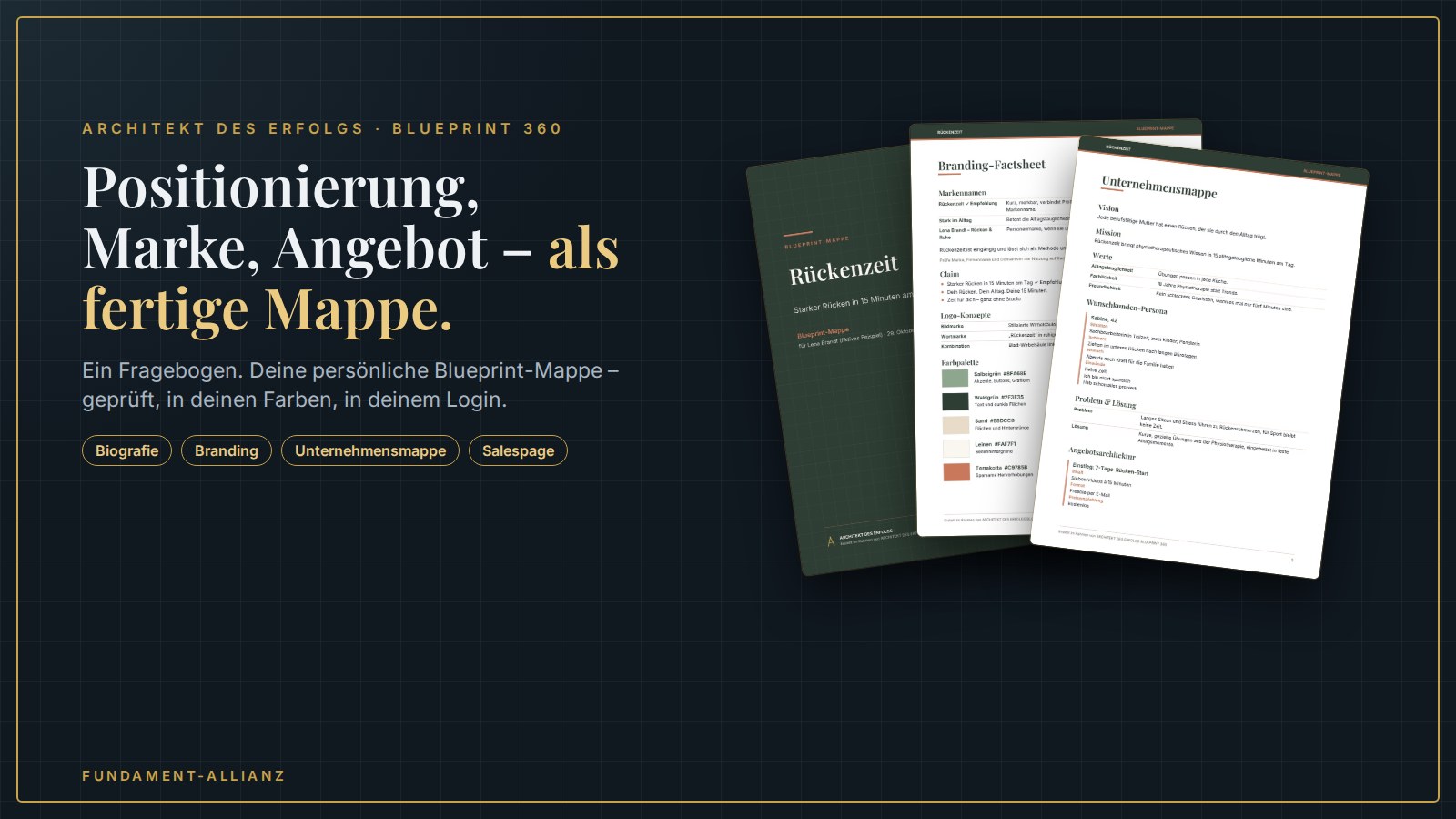
If you don't want to work out the first six steps on your own, there is the Marken-Blueprint 360° from Architekt des Erfolgs. You answer a detailed questionnaire about yourself, your knowledge and your goals. From it comes a complete identity package: your personal biography, a brand factsheet, a company folder, prompts for your brand images, a motivating one-pager and a text template for your sales page.
An example from practice: Sandra had previously spent a lot of money on countless courses and systems and wasn't getting anywhere. With the Blueprint she finally had a common thread and, within 8 weeks, her first sales. Results are of course individual and depend on effort, offer and starting position.
Our honest assessment
The Blueprint is meant for people who have learned enough and now need clarity and structure. It takes the thinking about your brand off your hands and gives you ready-made texts and documents. What it doesn't take off your hands: having conversations, approaching customers and staying the course. Anyone who isn't willing to do that won't build a business even with the best blueprint.
At €2,490, the Blueprint is a real investment. It is worthwhile above all for those who already sense that they aren't missing more knowledge, but a common thread.
Three bonuses when you get the Blueprint
To make the step after the Blueprint easier, there are three practical reports included: a 30-day client acquisition plan for your first customers, a blueprint for your lead magnet with a welcome email series, and a pricing blueprint for your offer. You can find all the details about the bonuses here: #bonuspageurl#
Frequently asked questions
How long does it take to build your own brand?
The basics, meaning story, target group, positioning and tone of voice, can be worked out in a few weeks with concentrated effort. It takes considerably longer until a brand is known in your market. What matters is to start having conversations early, instead of waiting for the perfect brand.
Do I need a professional logo to get started?
No. To begin with, a clean wordmark in an easily readable typeface is enough. It is much more important that you can say clearly who you work for and which problem you solve.
What is the difference between brand and positioning?
Positioning describes where you stand in the market: for whom, with which offer, and in contrast to whom. The brand additionally includes your story, your values, your tone of voice and your appearance. Positioning is therefore one part of the brand.
Can I still change my brand later?
Yes. Many self-employed people refine their brand in the first few years. The clearer you are at the start, the easier this is, because you know exactly what you are changing and why.

Blueprint360
You only get this bonus when you buy through our link. Nowhere else.
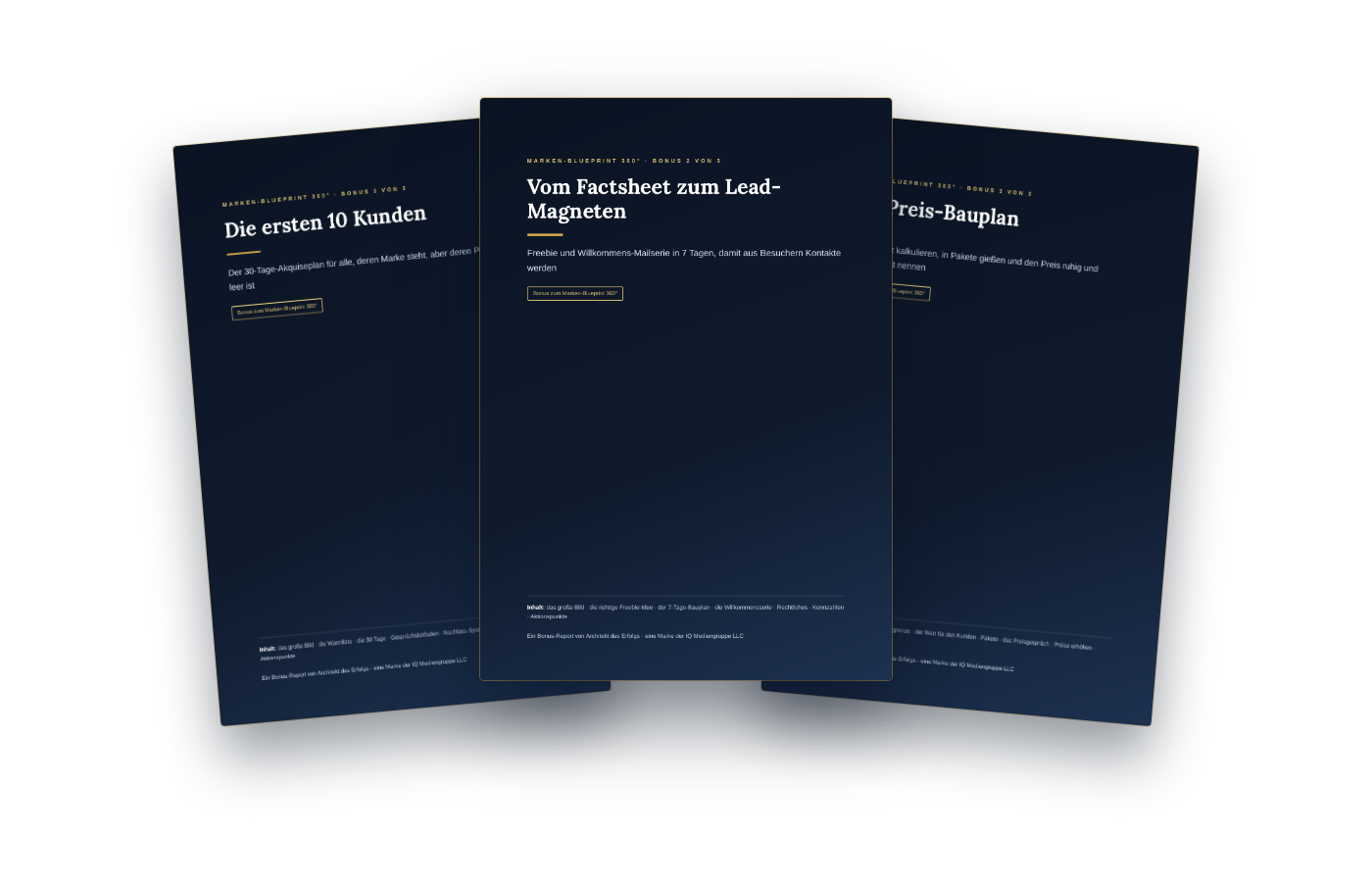
Deine 3 Blueprint360 Boni
€131Drei PDF-Reports im Architekt-des-Erfolgs-Design, 8 bis 9 Seiten, direkt umsetzbar.
- Die ersten 10 Kunden: Der 30-Tage-Akquiseplan
- Vom Factsheet zum Lead-Magneten
- Der Preis-Bauplan
Total value of your bonus package€131Value as stated by the provider
How to get your bonus
- Buy via one of the buttons
- Copy the order number from your confirmation
- Enter it here and claim your bonus
Ich bin der kompromisslose Typ, der für Experten und Coaches nach dem Prinzip „Beton statt Bullshit" arbeitet
Never miss an article
Sign up for new articles and the free Fundament-Allianz info pack.